Trending News

Ursula von der Leyen used her participation at the G7 summit in Kananaskis, Canada, to warn against a "new China shock" and denounce Beijing for perpetuating what she called a "pattern of dominance, dependency and blackmail" vis-à-vis its trading partners, in language seemingly designed to appeal to Donald Trump's agenda. China holds a quasi-monopolistic position over so-called rare earths, the 17 metallic elements that are crucial for advanced technologies.
Around 60% of the world's supply and 90% of the processing and refining capacity are controlled by the nation. During one of the meeting's thematic sessions, the president of the European Commission stated, "China is using this quasi-monopoly not only as a bargaining chip, but also to weaponize it to undermine competitors in key industries." She went on to say, "We all witnessed the cost and consequences of China's coercion through export restrictions," referring to Beijing's recent decision to restrict sales of seven kinds of rare earth minerals, which Brussels had deemed "alarming."
The move was a response to Trump's sweeping tariffs, which caused a rapid escalation of tit-for-tat measures with China. The two sides announced a detente last week with the intention of lowering the spiraling duties and loosening export restrictions. "Excellent relationship with China!" Trump said. But on Monday, von der Leyen sought to tap into the US-China rivalry to make the case for a "united" G7 front to counter Beijing's dominance with an "alternative network of trusted suppliers" and fresh investments in extraction and refining. "The threat persists despite indications that China may relax its restrictions. But there are other distortions. We are seeing a new 'China shock'," she said. "A common G7 response increases our leverage – pressuring China to take more responsibility for the impact of its state-led growth model."
Von der Leyen also blasted China for flooding global markets with "subsidised overcapacity that its market cannot absorb", name-checking the dispute over China-made electric vehicles that her Commission considers to be artificially cheaper. During another session at the summit, von der Leyen went further and declared that the source of "the biggest collective problem" in the global trading system dated back to China's accession to the World Trade Organization (WTO) in 2001. Beijing's entry into the WTO has been controversial, as it opened international markets to the mass production of low-cost exports. The admission is linked to the first "China shock" and a decline in manufacturing jobs in both Europe and the US. China continues to identify as a developing nation. This can't be true.
China has largely shown that it unwillingness to live within the constraints of the rules-based international system," von der Leyen said. "While others opened their market, China focused (on) undercutting intellectual property protections, massive subsidies with the aim to dominate global manufacturing and supply chains," she went on. "This is not competition in the market; it is intentional distortion." Looming deadline Von der Leyen's hard-line approach echoes many of the grievances voiced by the Trump administration, which is bent on curbing China's rise as an economic superpower and bringing back manufacturing jobs of strategic importance. It also tampers down growing speculation of a EU-China reset ahead of a bilateral summit in late July.
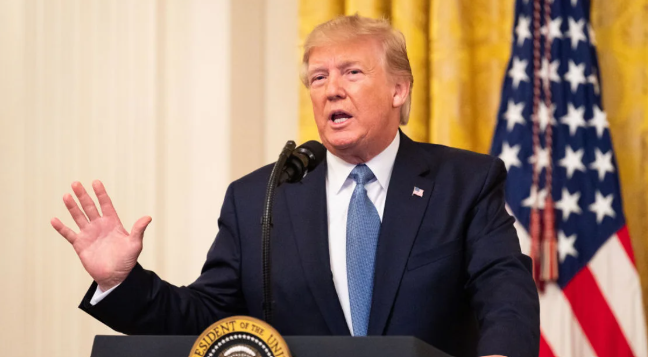
Von der Leyen's interventions were peppered with direct appeals to Trump, who was also present in the room, even if he left the summit one day earlier due to the military escalation between Israel and Iran. "Donald is right – there is a serious problem," she said, referring to China. Von der Leyen and her team struggled to gain access to the White House in the weeks immediately following Trump's inauguration. Brussels was alarmed by Trump's disruptive positions on Russia, Ukraine, Greenland, and the Middle East. Trump's self-styled "reciprocal tariffs" in early April opened a 90-day window of opportunity to strike a EU-US trade deal and yielded the long-awaited phone call between the two leaders, in which they agreed to fast-track negotiations.
The deadline might be pushed back, according to Trump administration officials, to give more time for negotiations. "On trade, we instructed the teams to accelerate their work to strike a good and fair deal," von der Leyen said on social media alongside a picture with Trump.
3 minute read

3 minute read