Trending News

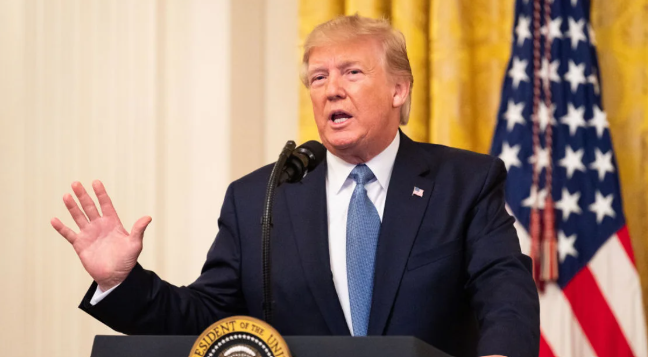
The government's public response to the Trump administration's tariffs on South Africa demonstrates how difficult the situation is for our nation. This kind of restrained and careful response is probably the only possible option, while our decision-makers may have to wait to see how the approaches of other countries fare with the Trump Administration. The decision made by President Donald Trump to levy tariffs of 30 percent on us and on all other nations can be comprehended in a variety of ways.
Standard Bank chief economist Goolam Ballim has suggested that it can be viewed as a “Brexit”, only instead of Britain leaving its trading relationship with the EU, the US is leaving its trading relationships with the entire world. This indicates that many leaders worldwide are currently confronted with the same issue, primarily as a result of the size of the US economy. They both have to respond in the way that will best protect their economies, and they appear to their own constituencies as if they are responding. This necessitates extremely robust leadership in some democracies. The primary issue in Canada's election is who will be more critical of Donald Trump.
Mexico, with a relatively newly elected leader, and a weaker economy, doesn’t have the luxury that Canada does. In the meantime, China, which is not democratic, has reacted by imposing a general tariff of 34% on all US goods. China is able to do this simply because it can. Additionally, it may be hoping that by simply announcing tariffs, it will be able to send the US stock market plummeting to such an extent that Trump will be forced to alter his course. Our country is very different, we have fewer levers with which to respond. As Trade, Industry and Competition Minister Parks Tau explained on Friday, 4 April, it would not be in the interests of our economy for our government to target the 600 US companies that have operations here. He is, of course, correct.
It would mean that South Africans lose jobs and antagonise Washington still further. Even though Minister of Mineral and Petroleum Resources Gwede Mantashe initially suggested that Africa as a whole should refuse to export its minerals to the United States, the suggestion is now emerging as one of the few viable options. But it would also cut off important sources of revenue for South Africans. On Thursday, in the hours after Trump’s announcement last week, Tau suggested he was planning to travel to the US to try and negotiate a trade deal. Presumably, this would be aimed at removing some of the tariffs and instituting some kind of rules to our trading relationship. But this could be fraught with danger too. There is every chance that no one from the Trump administration will meet with him.
The next option could be for President Cyril Ramaphosa to go too, to show both the US and South Africans how seriously he is taking this problem. But that too would be unwise. It would seem there could be no meeting that Ramaphosa could take part in that would not be taken over by discussions about our case against Israel at the International Court of Justice. Even normal photo-ops would be disrupted by Trump-supporting reporters spoiling for a fight over just that issue. Our government simply would not be able to obtain any substantive meetings in the United States, which is a sign of how the world is divided by Israel's actions in Gaza. For Ramaphosa, all of this poses particular problems.
In the past he has generally been able to manage disputes and difficult political problems through following process and rules, and sometimes, personal engagement. This time there is no process (even the World Trade Organisation currently is weaker than it should be), and no possibility of personal engagement. Read more: Trump’s tariff teardown, the broken maths behind it and the global fallout Read more: Tariff turmoil: South Africa opts for diplomacy over quick retaliation in trade dispute Trump wants ‘no rules’ Also, Trump has made it clear he wants no rules, and that anyone he sees as weaker than him is a “loser”. This is all part of his long-term plan, to amass as much power and wealth as possible for himself and his entourage. It now seems likely that a massive international natural experiment is about to occur.
It seems that while different countries face very similar problems in responding to Trump, they are going to respond in a variety of ways. Some of these will be more successful than others. Thus it would be rational to wait and see what happens before coming up with any kind of response that can’t later be dialled back. Also, these tariffs will have a huge impact on the US economy. At some point Trump might well be forced to change course. That means it would be foolish to do anything on our part that could damage relations with the US permanently. This may rule out approaches that may satisfy a domestic constituency (such as siding more closely with BRICS nations, or Russia, or Palestine). But there is a clear need for more action from the government in other areas.
As many have pointed out, this is the perfect time for South Africa to take more of a leading role in encouraging more trade with other African countries. We may find that we can use our presidency of the G20 to urgently create a new trading bloc that excludes the US. This should be much easier than it sounds, because so many countries have now lost the US as a market, and they too will be looking for partners to increase their trade with. It will also lead to some difficulties. For example, the EU is likely to have to forget about their criticisms of the anti-democratic actions of China’s government, simply to facilitate more trade. Something similar could happen to us too. And, of course, it would be foolish to run from the arms of one bully in the US, to another bully, in the form of China.
Minister must rise to the occasion It is clear that the Department of Trade, Investment and Competition will now become a priority for the government. It will need more capacity, more economists and analysts and more resources to improve the way it handles trade matters. Crucially, Tau will have to rise to the occasion too. He will need to be seen to display leadership, both in explaining why South Africa is not hitting back against the US, and yet not appearing to be simply caving in. In the meantime, our government will also have to see what other consequences there are. Before Trump’s announcement the US bought around 8% of our exports, and already shipments of wine have been sent back. Oranges that were destined for California now have no buyer. This could result in strange outcomes.
It is entirely possible that in the short-term the only possible consumer of these oranges is South Africa itself. And Old Mutual chief economist Johann Els has explained that the US tariffs are likely to lead to a recession there, and thus a weaker dollar. As a result, the rand will be stronger against the dollar, which would result in lower inflation here, and that could allow the SA Reserve Bank to cut interest rates. At the same time, the EU and China will now be forced to take action to grow their economies (and European countries are now spending a large amount of money on defence) so the global economy could start to grow in a significant way.
All of this means that for South Africa, the economic impact of Trump’s tariffs are much more complex than simply seeing them as negative. This would also suggest that Tau and other leaders need to wait before taking any definitive action. So aggressive and abrasive are the actions and comments of the Trump administration that it is tempting to demand immediate action from our government. Instead, it will probably be better to move carefully and slowly, and not do anything that could alienate the US permanently.

US President Donald Trump is doubling down against the BRICS bloc of fast-growing economies — including Brazil, Russi...
5 minute read
5 minute read